Kalapodi. A Phocian Sanctuary with a Long Tradition

In the shadow of Mount Parnassus, near Kalapodi, lies an ancient sanctuary, likely the venerable Oracle of Apollo at Abae. Excavations by the DAI have uncovered two parallel temple complexes, a section of the enclosure wall, and several auxiliary buildings, which attest to continuous use from the Mycenaean period through Late Antiquity.

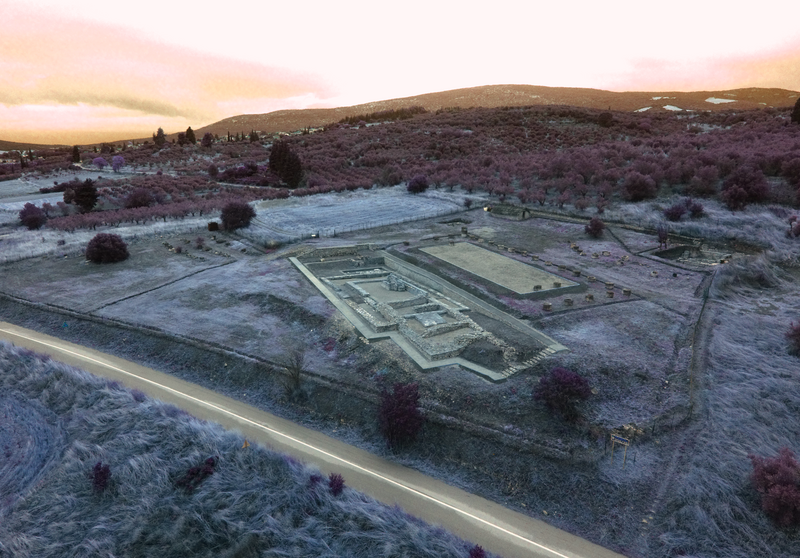
Das Grabungsgelände von Osten nach Denkmalpflege in beiden Tempelarealen 2023, Foto S. Biernath © DAI Athen // S. Biernath

DAI Standort  Athens Department

Projektart  Verbundforschung mit Teilprojekten

Laufzeit  01.01.2004 - 31.12.2028

Disziplinen  Prähistorische und historische Archäologie, Bauforschung, Archäometrie

Projektverantwortlicher  Prof. Dr. Katja Sporn, Dr. Themistoklis Bilis

Adresse  Fidiou 1 , 10678 Athen

Email  Katja.Sporn@dainst.de

Team  Ausgr.-Ing. Stefan Biernath, Angelos Sotiropoulos

Laufzeit  2004 - 2028

Projektart  Verbundforschung mit Teilprojekten

Cluster/Forschungsplan  ATH - Region und Struktur

Fokus  Feldforschung, Infrastrukturprojekte, Kulturerhalt/Cultural Heritage, Objektforschung, Verbundforschung

Disziplin  Prähistorische und historische Archäologie, Bauforschung, Archäometrie

Methoden  Architektonische Bauaufnahme, Dokumentation, Elektronische Datenverarbeitung, Feldforschung, Grabungsmethoden, Restaurierungs- und Denkmalpflegemethoden

Partner  Griechisches Kulturministerium, Ephorie für Altertümer von Fthiotida und Evrytania, National Center for Scientific Research 'Demokritos' (NCSR 'Demokritos'), Institute of Materials Science, Laboratory of Archaeometry, Christian-Albrechts-Universität zu Kiel, Institut für Geowissenschaften, Natural Sciences Unit at the Head Office, University of Nottingham, Department of Classics and Archaeology, American School of Classical Studies at Athens, Malcolm H. Wiener Laborator

Förderer  Regula Pestalozzi Stiftung, Ephorie für Altertümer von Fthiotida und Evrytania, Athens Department

Schlagworte  Bauforschung, Klassische Archäologie, Prähistorische und historische Archäologie, religiöse Feste, Tempel

Projekt-ID  5990

Permalink  https://www.dainst.org/projekt/-/project-display/25884

Overview

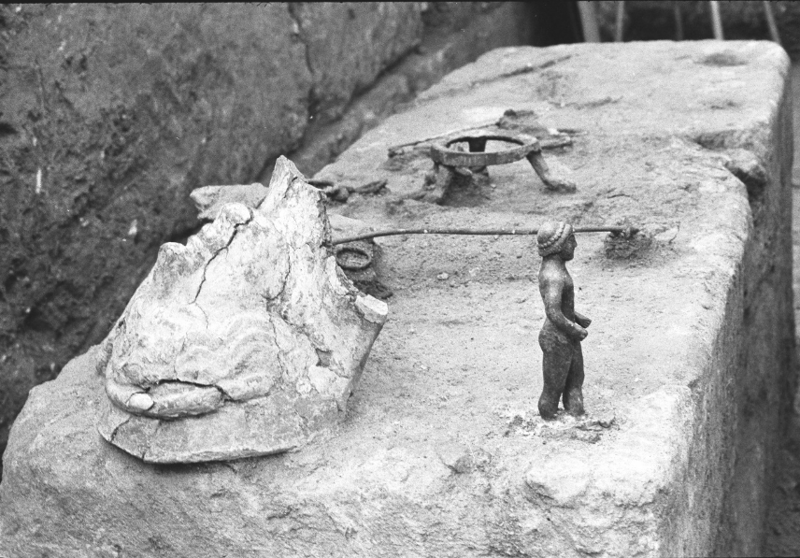
The modern settlement of Kalapodi is situated in Central Greece, east of Mt. Parnassus, in a region that belonged to Phocis in antiquity. East of the village lies a sanctuary with two parallel temple complexes. Significant finds including bronzes, weapons, pottery, and numerous small finds, like Mycenaean seal stones, demonstrate that the local importance of a sanctuary with interregional influence. For the first time in Greece, it was possible to prove a cult continuity from the Late Bronze Age into the Early Iron Age there. Numerous architectural phases, beginning in Late Helladic III A1 and continuing into Late Antiquity, attest to the continuous use of the sacred space, while Byzantine-era burials indicate subsequent reuse.

Heritage Protection at Kalapodi

A new monument protection concept devised by Themistoklis Bilis and Maria Magnisali between 2014 and 2016 and approved by the Central Archaeological Council began in 2017. The concept initially envisioned a new protective roof over the South Temple area, intended to replace the old, provisional shelter. This plan was later superseded by more intensive restoration and backfilling measures in the South Temple area, which allowed the project to forgo a permanent protective roof. The company Lithou Sinitiris developed this restoration concept, as well as a detailed study for the restoration and lifting of the South Temple's west pediment, which was found in situ in 2009. Both plans were implemented starting in 2018. The pediment blocks were restored, lifted, and subsequently re-set after the excavation of the area beneath them. In addition, a path system was established around the South Temple. Furthermore, in 2022/23, several column drums were re-set over the original locations of the North Temple, which had been backfilled after the close of excavations in 1982.

A major challenge to monument preservation is posed by water. Due to the north-south gradient of the site, one issue is rainwater, another ice and snow in winter. A system of trenches and drainage now facilitate the runoff of rainwater. In 2023, the EU project TRIQUETRA began, in which the DAI Athens participates with a study focused on protecting the monuments of Kalapodi from frost damage.
The provisional altar in the North Temple after the 1976 excavation © DAI Athen // R. Felsch
[Translate to Englisch:] Kalapodi_Südtempel_Gesamtansicht.jpg
The South Temple complex after uncovering the western gable in 2009, view from the east © DAI Athen // W.-D. Niemeier
North Syrian bowl from the South Temple © DAI Athen // W.-D. Niemeier
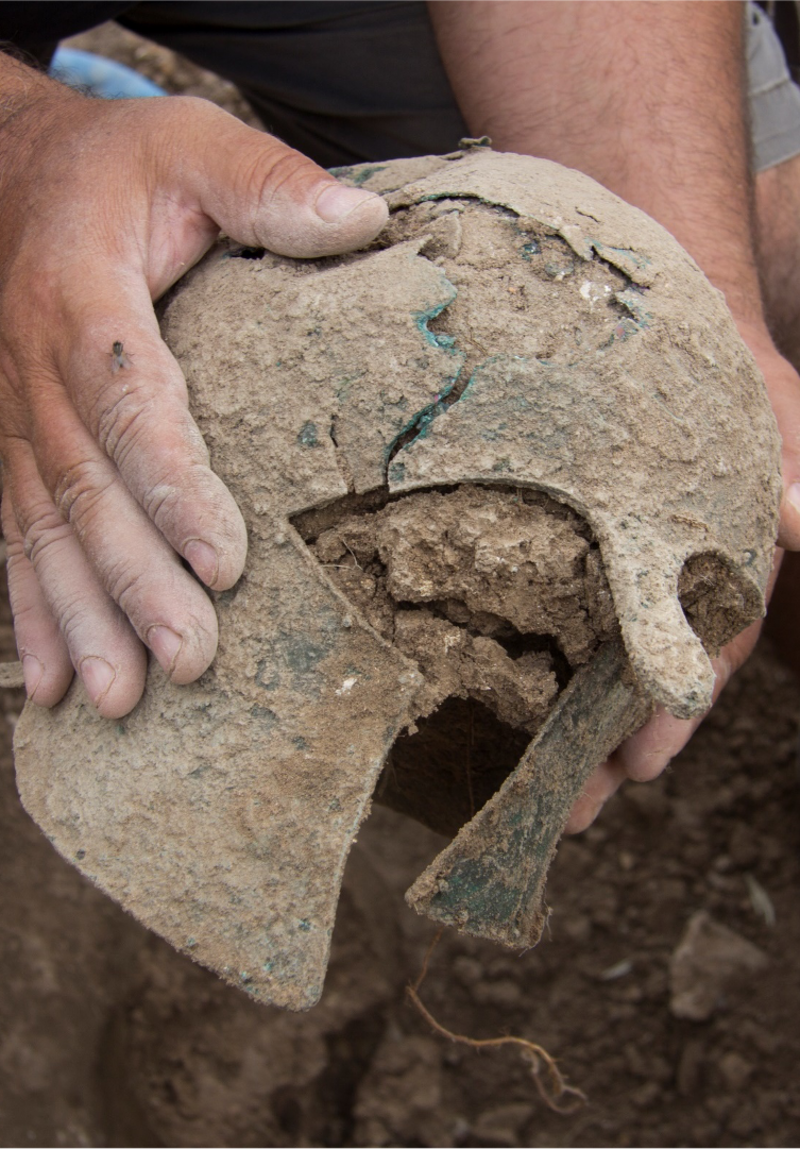
Discovery of an almost completely preserved Corinthian helmet in 2016 © DAI Athen // K. Sporn
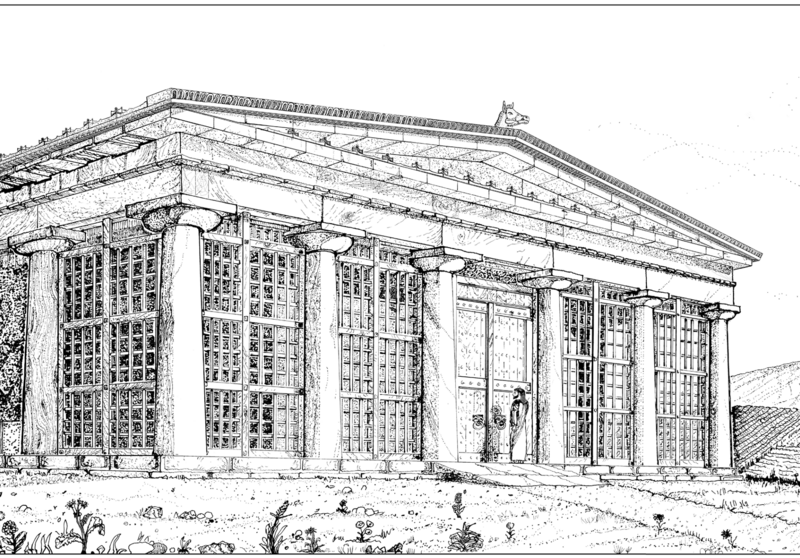
Drawing of the west view of the archaic South Temple © DAI Athen // N. Hellner
Digitale Rekonstruktion des Pferdekopfakroters vom Westgiebel des archaischen Südtempel, Grafik O. Bruderer © DAI Athen // O. Bruderer
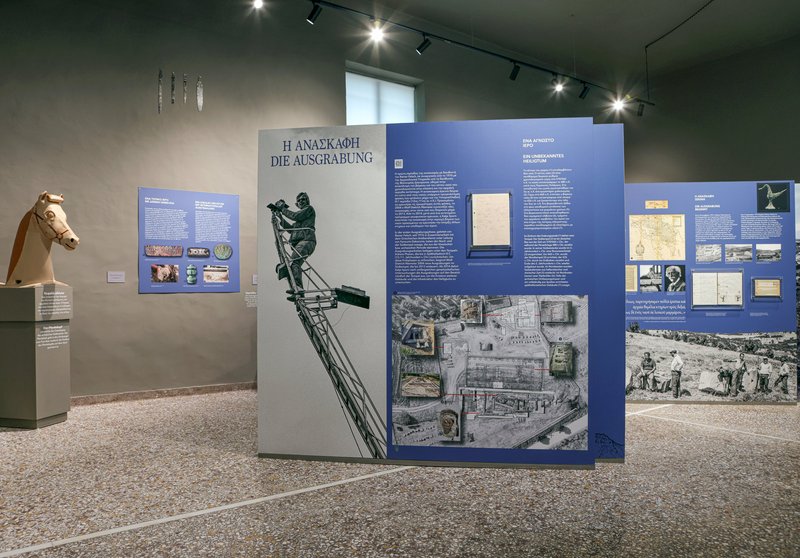
View of the photo exhibition "Schnitt in die Vergangenheit. 50 Jahre Grabung Kalapodi," which opened on 5 September 2023 in the old village school in Kalapodi to mark the 50th anniversary of the groundbreaking ceremony. © DAI Athen // N. Chrisikakis
[Translate to Englisch:] Kalapodi_Grabungsgelände_vonOsten_D-DAI-ATH-2017-4084.jpg
The excavation site from the east, looking towards Mount Parnassus in 2017, with the old protective roof over the south temple complex © DAI Athen // H. Birk
The excavation site from the east after monument preservation in both temple areas in 2023 © DAI Athen // S. Biernath